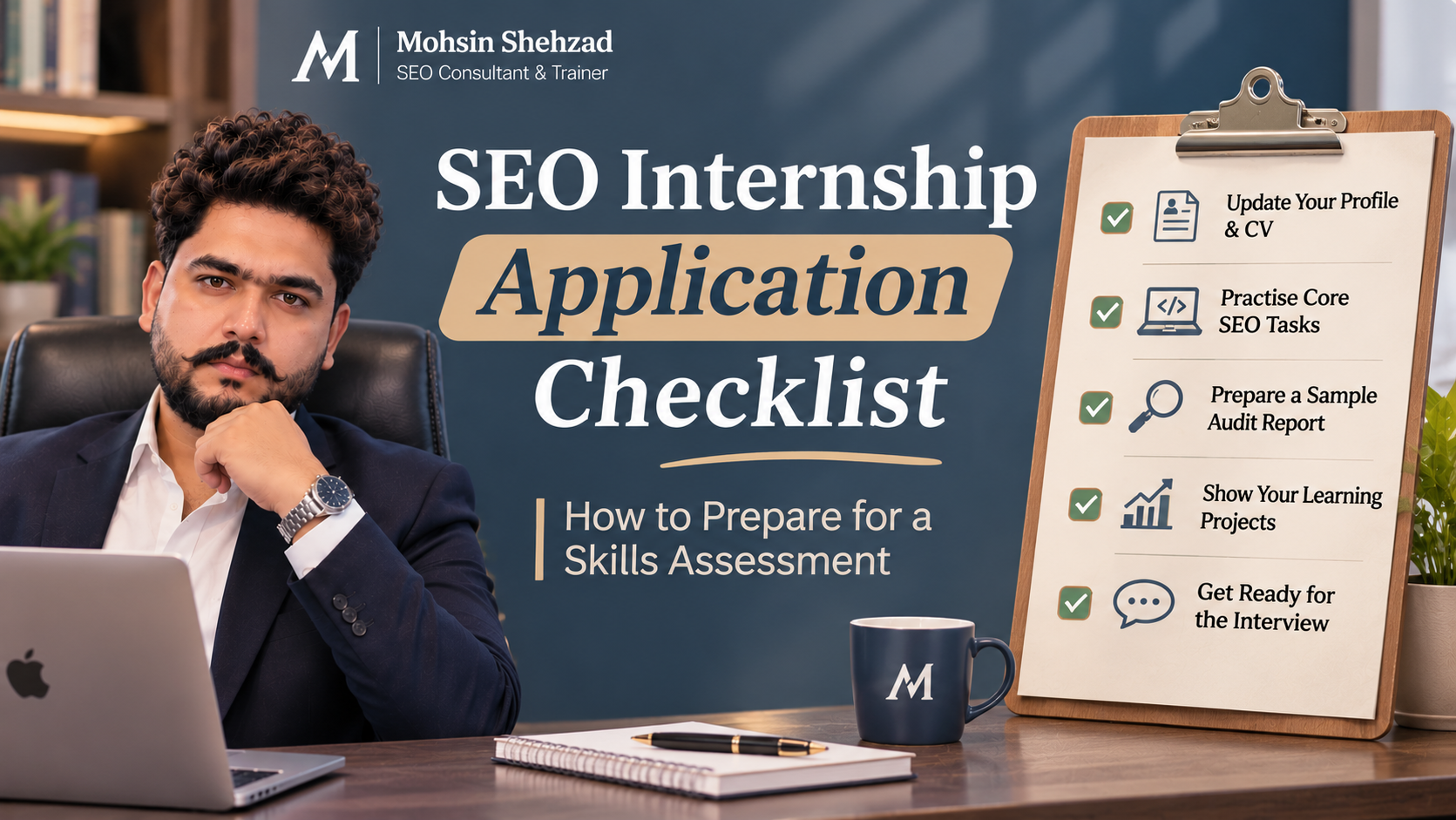
SEO Internship Application Checklist: How to Prepare for a Skills Assessment

Quote from SEOInternshipApplication on November 13, 2026, 6:45 amSEO Internship Application Checklist: How to Prepare for a Skills Assessment
Applying for an SEO internship can be an important first step for students, fresh graduates, and beginners interested in digital marketing. However, many applicants feel uncertain about what they should know before applying or how their skills might be evaluated.
A useful SEO internship application should demonstrate your willingness to learn, your understanding of basic concepts, and your ability to explain practical work honestly.
You do not need to present yourself as an experienced SEO professional if you are still learning.
Instead, focus on preparing a clear introduction, understanding essential SEO terminology, and practising simple research and website analysis tasks.
This guide explains how to prepare for an internship enquiry or skills assessment without relying on memorized answers or exaggerated experience claims.
1. Understand the Internship Requirements Before Applying
Before submitting an application, review the programme's purpose, duration, learning arrangement, and eligibility expectations.
Different internships serve different audiences.
Some are designed for complete beginners, while others expect applicants to have prior knowledge of website optimization or digital marketing tools.
Mohsin Shehzad's published training information describes a six-month SEO internship pathway, primarily conducted onsite in Lahore, with no training fee.
The website encourages applicants to share their current skills, goals, and availability so that their suitability and starting requirements can be discussed.
The published learning roadmap is flexible rather than a guaranteed timetable.
Applicants should confirm current attendance conditions and any stipend or completion-document arrangements directly before joining.
2. Prepare a Clear and Accurate Introduction
An internship enquiry should explain who you are and why you want to learn SEO.
You can briefly mention your education, existing computer knowledge, and any relevant learning activities.
For example, a beginner might explain that they have studied basic keyword research and want to develop practical website optimization skills.
Avoid claiming professional experience that you cannot demonstrate.
A clear introduction helps the training provider understand your starting point.
You should also explain whether you can attend onsite and how much time you can realistically commit to practical learning.
Honest communication is more useful than presenting an impressive but inaccurate profile.
3. Review Essential SEO Concepts Before an Assessment
Applicants should understand the basic purpose of search engine optimization.
SEO involves improving website accessibility, relevance, and usefulness so that search engines and users can better understand its content.
Beginners should know the difference between organic and paid search results.
They should also understand basic terms such as keywords, search intent, crawling, indexing, internal links, and on-page optimization.
Mohsin Shehzad's SEO training in Lahore connects these concepts with guided practical learning and assessment. The published programme includes search fundamentals, keyword research, content planning, technical SEO, local SEO, and reporting.
These topics provide a useful learning framework, although the website does not publish a fixed entrance-test syllabus.
Practise Explaining Concepts in Your Own Words
Instead of memorizing complicated definitions, practise explaining simple examples.
For instance, you should be able to describe why a service page and an educational article may target different search queries.
Clear explanations demonstrate understanding more effectively than repeating technical terminology without context.
4. Practise a Basic Keyword Research Assignment
Keyword research is a useful beginner exercise because it connects search behaviour with website planning.
Choose a hypothetical business, such as a local cleaning company.
Identify a few queries that potential customers might search for.
Separate informational questions from searches suggesting interest in a service.
Then explain which keywords might belong on a service page and which could support an educational article.
Do not invent search volumes or keyword difficulty scores.
If you do not have access to reliable keyword data, describe your research as a qualitative exercise.
The objective is to demonstrate logical thinking rather than produce a large keyword list.
5. Prepare a Simple Website Review
A basic website review can help demonstrate your ability to observe and organize information.
Choose a website you own or have permission to assess.
Review visible elements such as page titles, headings, internal links, navigation, and content relevance.
Identify one or two observations and explain why they may deserve further investigation.
For example, you might notice that a service page does not clearly explain what the business offers.
Rather than claiming that the page has poor rankings because of this issue, explain how clearer information could improve usefulness for visitors.
Avoid modifying websites without authorization.
A beginner assessment should demonstrate careful reasoning, not risky technical implementation.
6. Learn Basic Google Search Console Concepts
Google Search Console is an important tool for understanding aspects of website performance in Google Search.
Beginners should know that its reports include information about clicks, impressions, search queries, and indexing conditions.
They should also understand that crawling and indexing are different processes.
A page can be crawled without being indexed, and indexing does not guarantee a particular ranking position.
You do not need access to confidential client accounts to learn these concepts.
Official documentation, appropriate demonstrations, and supervised practice can provide useful starting points.
If an assessment includes a technical question, explain what you know and identify what additional evidence would be needed.
This is more responsible than guessing.
7. Organize Your Practice Work Into a Small Portfolio
A beginner portfolio does not need to contain paid client projects.
You can include clearly labelled practice assignments, such as a keyword map, content brief, or sample website review.
Each example should explain the task, your method, and what you learned.
If a project was hypothetical, state that clearly.
Do not present simulated results as genuine ranking improvements or traffic growth.
You should also avoid sharing confidential business documents or private analytics screenshots without permission.
A small portfolio of honest work can help reviewers understand your current abilities and learning potential.
8. Prepare for Questions About Your Learning Approach
An internship discussion may explore how you respond to unfamiliar tasks and feedback.
You might be asked what you would do if you encountered a website issue you did not understand.
A responsible answer would involve documenting the observation, checking relevant information, and asking for guidance before making risky changes.
Applicants should also be prepared to discuss their availability and learning goals.
The ability to explain your reasoning and acknowledge uncertainty is valuable.
You do not need to know every technical answer before starting an entry-level learning pathway.
9. Understand What an Internship Does Not Guarantee
An internship can provide learning opportunities, but it should not be confused with a guaranteed job offer.
Completion does not automatically establish expert status or professional certification.
Progress depends on individual participation, practice, feedback, and demonstrated understanding.
Applicants should also distinguish between a programme with no training fee and a paid internship.
The absence of a training fee does not automatically mean that participants receive a stipend.
Before committing, clarify the current conditions directly with the provider.
Realistic expectations help applicants make informed decisions.
Final Thoughts
Preparing for an SEO internship application involves more than updating a CV.
Beginners should understand the programme requirements, review foundational SEO concepts, practise simple assignments, and communicate their learning goals clearly.
Honest project documentation and careful problem-solving are more useful than exaggerated experience claims.
The strongest preparation focuses on understanding why SEO tasks matter and knowing when additional evidence or supervision is necessary.
With a clear introduction, basic knowledge, and realistic expectations, applicants can approach internship discussions more confidently.
Frequently Asked Questions
1. Can beginners apply for an SEO internship without experience?
Yes, some programmes accept beginners. Applicants should review eligibility requirements and explain their current knowledge honestly.
2. What should I study before an SEO internship assessment?
Useful starting topics include search fundamentals, keyword research, search intent, on-page SEO, crawling, indexing, and basic reporting.
3. Do I need a portfolio to apply for an SEO internship?
Not every programme requires one. However, a few clearly labelled practice assignments can help demonstrate your learning.
4. Does an SEO internship guarantee a permanent job?
No. Employment depends on individual performance, available opportunities, and employer requirements.
5. How can I prepare for an SEO internship interview?
Review basic SEO concepts, practise explaining your work, understand the programme requirements, and prepare honest answers about your goals and availability.
SEO Internship Application Checklist: How to Prepare for a Skills Assessment
Applying for an SEO internship can be an important first step for students, fresh graduates, and beginners interested in digital marketing. However, many applicants feel uncertain about what they should know before applying or how their skills might be evaluated.
A useful SEO internship application should demonstrate your willingness to learn, your understanding of basic concepts, and your ability to explain practical work honestly.
You do not need to present yourself as an experienced SEO professional if you are still learning.
Instead, focus on preparing a clear introduction, understanding essential SEO terminology, and practising simple research and website analysis tasks.
This guide explains how to prepare for an internship enquiry or skills assessment without relying on memorized answers or exaggerated experience claims.
1. Understand the Internship Requirements Before Applying
Before submitting an application, review the programme's purpose, duration, learning arrangement, and eligibility expectations.
Different internships serve different audiences.
Some are designed for complete beginners, while others expect applicants to have prior knowledge of website optimization or digital marketing tools.
Mohsin Shehzad's published training information describes a six-month SEO internship pathway, primarily conducted onsite in Lahore, with no training fee.
The website encourages applicants to share their current skills, goals, and availability so that their suitability and starting requirements can be discussed.
The published learning roadmap is flexible rather than a guaranteed timetable.
Applicants should confirm current attendance conditions and any stipend or completion-document arrangements directly before joining.
2. Prepare a Clear and Accurate Introduction
An internship enquiry should explain who you are and why you want to learn SEO.
You can briefly mention your education, existing computer knowledge, and any relevant learning activities.
For example, a beginner might explain that they have studied basic keyword research and want to develop practical website optimization skills.
Avoid claiming professional experience that you cannot demonstrate.
A clear introduction helps the training provider understand your starting point.
You should also explain whether you can attend onsite and how much time you can realistically commit to practical learning.
Honest communication is more useful than presenting an impressive but inaccurate profile.
3. Review Essential SEO Concepts Before an Assessment
Applicants should understand the basic purpose of search engine optimization.
SEO involves improving website accessibility, relevance, and usefulness so that search engines and users can better understand its content.
Beginners should know the difference between organic and paid search results.
They should also understand basic terms such as keywords, search intent, crawling, indexing, internal links, and on-page optimization.
Mohsin Shehzad's SEO training in Lahore connects these concepts with guided practical learning and assessment. The published programme includes search fundamentals, keyword research, content planning, technical SEO, local SEO, and reporting.
These topics provide a useful learning framework, although the website does not publish a fixed entrance-test syllabus.
Practise Explaining Concepts in Your Own Words
Instead of memorizing complicated definitions, practise explaining simple examples.
For instance, you should be able to describe why a service page and an educational article may target different search queries.
Clear explanations demonstrate understanding more effectively than repeating technical terminology without context.
4. Practise a Basic Keyword Research Assignment
Keyword research is a useful beginner exercise because it connects search behaviour with website planning.
Choose a hypothetical business, such as a local cleaning company.
Identify a few queries that potential customers might search for.
Separate informational questions from searches suggesting interest in a service.
Then explain which keywords might belong on a service page and which could support an educational article.
Do not invent search volumes or keyword difficulty scores.
If you do not have access to reliable keyword data, describe your research as a qualitative exercise.
The objective is to demonstrate logical thinking rather than produce a large keyword list.
5. Prepare a Simple Website Review
A basic website review can help demonstrate your ability to observe and organize information.
Choose a website you own or have permission to assess.
Review visible elements such as page titles, headings, internal links, navigation, and content relevance.
Identify one or two observations and explain why they may deserve further investigation.
For example, you might notice that a service page does not clearly explain what the business offers.
Rather than claiming that the page has poor rankings because of this issue, explain how clearer information could improve usefulness for visitors.
Avoid modifying websites without authorization.
A beginner assessment should demonstrate careful reasoning, not risky technical implementation.
6. Learn Basic Google Search Console Concepts
Google Search Console is an important tool for understanding aspects of website performance in Google Search.
Beginners should know that its reports include information about clicks, impressions, search queries, and indexing conditions.
They should also understand that crawling and indexing are different processes.
A page can be crawled without being indexed, and indexing does not guarantee a particular ranking position.
You do not need access to confidential client accounts to learn these concepts.
Official documentation, appropriate demonstrations, and supervised practice can provide useful starting points.
If an assessment includes a technical question, explain what you know and identify what additional evidence would be needed.
This is more responsible than guessing.
7. Organize Your Practice Work Into a Small Portfolio
A beginner portfolio does not need to contain paid client projects.
You can include clearly labelled practice assignments, such as a keyword map, content brief, or sample website review.
Each example should explain the task, your method, and what you learned.
If a project was hypothetical, state that clearly.
Do not present simulated results as genuine ranking improvements or traffic growth.
You should also avoid sharing confidential business documents or private analytics screenshots without permission.
A small portfolio of honest work can help reviewers understand your current abilities and learning potential.
8. Prepare for Questions About Your Learning Approach
An internship discussion may explore how you respond to unfamiliar tasks and feedback.
You might be asked what you would do if you encountered a website issue you did not understand.
A responsible answer would involve documenting the observation, checking relevant information, and asking for guidance before making risky changes.
Applicants should also be prepared to discuss their availability and learning goals.
The ability to explain your reasoning and acknowledge uncertainty is valuable.
You do not need to know every technical answer before starting an entry-level learning pathway.
9. Understand What an Internship Does Not Guarantee
An internship can provide learning opportunities, but it should not be confused with a guaranteed job offer.
Completion does not automatically establish expert status or professional certification.
Progress depends on individual participation, practice, feedback, and demonstrated understanding.
Applicants should also distinguish between a programme with no training fee and a paid internship.
The absence of a training fee does not automatically mean that participants receive a stipend.
Before committing, clarify the current conditions directly with the provider.
Realistic expectations help applicants make informed decisions.
Final Thoughts
Preparing for an SEO internship application involves more than updating a CV.
Beginners should understand the programme requirements, review foundational SEO concepts, practise simple assignments, and communicate their learning goals clearly.
Honest project documentation and careful problem-solving are more useful than exaggerated experience claims.
The strongest preparation focuses on understanding why SEO tasks matter and knowing when additional evidence or supervision is necessary.
With a clear introduction, basic knowledge, and realistic expectations, applicants can approach internship discussions more confidently.
Frequently Asked Questions
1. Can beginners apply for an SEO internship without experience?
Yes, some programmes accept beginners. Applicants should review eligibility requirements and explain their current knowledge honestly.
2. What should I study before an SEO internship assessment?
Useful starting topics include search fundamentals, keyword research, search intent, on-page SEO, crawling, indexing, and basic reporting.
3. Do I need a portfolio to apply for an SEO internship?
Not every programme requires one. However, a few clearly labelled practice assignments can help demonstrate your learning.
4. Does an SEO internship guarantee a permanent job?
No. Employment depends on individual performance, available opportunities, and employer requirements.
5. How can I prepare for an SEO internship interview?
Review basic SEO concepts, practise explaining your work, understand the programme requirements, and prepare honest answers about your goals and availability.
Uploaded files: