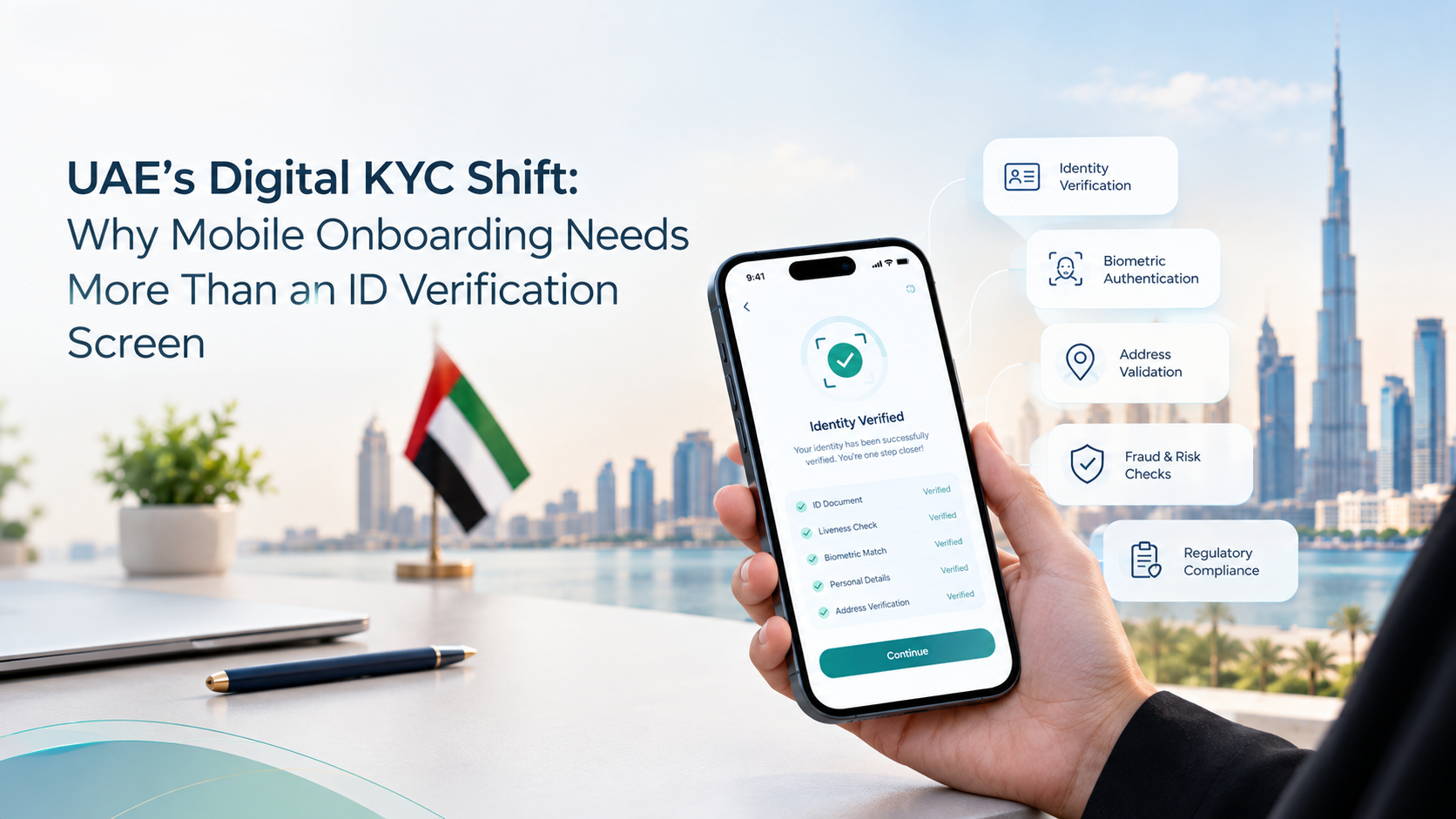
UAE’s Digital KYC Shift: Why Mobile Onboarding Needs More Than an ID Verification Screen

Quote from Junkies Coder on October 9, 2026, 9:26 amA customer uploads an identity document, completes a verification step and waits for approval. The screen shows that the request is being processed, but the application does not explain what happens next. If verification fails, the customer may have to start again. If the same request is submitted twice, the business may end up with duplicate records that require manual review.
For a digital product, this is more than a frustrating onboarding experience. It is a workflow-design problem involving identity data, verification services, application states and decisions about what the user is allowed to do next.
In the UAE, digital Know Your Customer (KYC) infrastructure is also becoming a more important regulatory and technology consideration. Federal Decree-Law No. 30 of 2024 addresses the KYC Digital Platform, and Cabinet Resolutions No. 55 and No. 56 of 2026 establish its executive regulations and administrative violations and sanctions framework. These rules have a defined legal scope; they should not be interpreted as imposing identical KYC obligations on every mobile application. Official KYC legislation | 2026 executive regulations | 2026 violations and sanctions.
For product teams, the practical question is how to build onboarding that is reliable, understandable and appropriate to the service being offered.
The real onboarding problem begins when verification does not go as planned
Many development teams design the ideal journey first: the customer enters their details, submits documents, passes verification and reaches the dashboard.
Real users do not always follow that sequence.
A document may be unreadable. Information may not match the records held by a verification provider. A third-party service may time out. A customer may close the app before receiving a result, then reopen it and submit the same request again.
If these situations are not accounted for in the architecture, the application can become difficult to recover, even when its primary verification integration works correctly.
A robust onboarding flow needs to answer three questions at every stage:
What has the system successfully received and verified?
What action is the customer allowed to take now?
What should happen if the next step fails?
These answers should be reflected in both the interface and the backend, not left to customer support to resolve manually.
Four engineering decisions that make digital onboarding more dependable
1. Treat verification as a sequence of explicit states
A verification process should not be represented by a single generic status such as “pending.”
Depending on the provider and service, the application may need to distinguish between a request that has not been submitted, one that is processing, one that requires additional information, one that has been approved and one that has failed.
These states matter because each permits different actions. A user waiting for a result should not unknowingly create a second application. Someone asked to correct a document should understand exactly what needs to change.
A state-based workflow also makes support easier. Instead of asking customers to explain what happened, authorised staff can investigate the recorded stage of the process.
2. Design recovery before connecting the verification provider
Third-party identity services can experience delays or temporary outages. A mobile app must distinguish a failed verification from a failure to receive the verification result.
Those are not the same thing.
If a network request times out, the backend may not know whether the provider completed the operation. Immediately submitting a new request could create duplicates or inconsistent records.
A more resilient implementation uses unique request identifiers, controlled retries, status checks and clear recovery rules. The application should preserve the existing request where possible and tell the customer whether to wait, retry or provide additional information.
The exact mechanism depends on the provider's API and capabilities, but the principle is consistent: a communication failure should not automatically become a second verification attempt.
3. Separate identity verification from permission to use a service
Verifying a person's identity does not automatically establish that every action in an application should be permitted.
A product may have separate requirements for identity confirmation, eligibility checks, account approval and access to sensitive features. These decisions should be modelled explicitly.
For example, an application might allow a customer to save an incomplete profile while restricting access to a transaction that requires additional approval. Another service might need a different sequence altogether.
This separation makes the product easier to adapt when business rules change. It also prevents a successful identity check from being treated as a universal approval for every subsequent operation.
4. Build a reliable record of what happened
When an onboarding case requires investigation, teams need to understand the sequence of events without exposing unnecessary personal information.
Useful operational records may include request identifiers, state transitions, timestamps, the source of a verification result and the reason an action was accepted or rejected. Access to these records should be controlled, and sensitive data should not be copied into ordinary application logs without a justified need.
Where applicable, the platform must also support relevant requirements for protecting, updating and handling KYC information. The UAE's specific KYC Digital Platform rules contain requirements directed at the entities and activities within their scope; businesses should assess those obligations with qualified legal or compliance professionals before translating them into technical specifications.
What changes when onboarding depends on several systems?
A modern onboarding journey may involve a mobile interface, a backend service, an identity-verification provider, an internal customer database and a decision engine.
Each connection creates a potential failure point. One system may return a result while another is unavailable. A user may change information while a previous request is still processing. An update may reach the database but fail to reach the mobile interface.
The architecture should define which system is authoritative for each decision and how the application recovers from incomplete operations.
Before launch, teams should test scenarios such as:
The identity provider returns a delayed response.
A customer closes the app during verification.
The same submission is sent more than once.
A verification result conflicts with an existing customer record.
A previously approved record requires correction or updating.
A user requests access to information they are not authorised to see.
These tests help expose failures that a standard demonstration rarely reveals.
How should businesses measure onboarding quality?
A high verification completion rate is useful, but it does not tell the whole story. A product could have a high completion rate while creating excessive manual work or making failed applications difficult to recover.
A more informative measurement framework includes:
Completion rate: The proportion of eligible users who complete the required onboarding process.
Recovery rate: The proportion of failed or interrupted journeys that are successfully resolved without starting from scratch.
Duplicate-request rate: How often repeated submissions create unnecessary records or processing.
Manual-review burden: The amount of staff time required to investigate cases that could have been handled through clearer workflows.
Time to a final decision: How long customers wait for a meaningful outcome, including cases that require additional information.
Security and privacy incidents: Whether access controls, data handling and operational safeguards perform as intended.
Metrics should be interpreted together. Reducing verification time is not a success if it weakens the controls required for the service.
Choosing a mobile app development partner in Dubai and the wider UAE
A business evaluating a mobile app development company in Dubai should ask how the team handles asynchronous verification, interrupted requests, duplicate submissions and changes to customer records.
The discussion should include more than the visual design of the onboarding screens. Ask to see the proposed state model, API failure handling, permissions architecture and test scenarios.
When selecting a mobile app development company in UAE, businesses should also assess how the team will coordinate with existing identity providers, internal systems and compliance stakeholders. If the product falls within a regulated activity, the applicable requirements should be confirmed before implementation begins.
A useful discovery exercise is to map the complete journey from the first customer submission to the final decision. For every stage, document the responsible system, the information being exchanged, the possible outcomes and the recovery path.
That map becomes a practical foundation for development, testing and ongoing monitoring.
The next step is not more verification screens
Adding more identity checks does not automatically create a safer product. Nor does removing friction necessarily improve onboarding.
The goal is to collect and verify the information the service legitimately needs, apply the correct controls and make the outcome understandable to the customer. When something goes wrong, the system should preserve the existing case, provide a clear next step and give authorised teams enough information to investigate.
For UAE businesses building digital services, dependable onboarding is ultimately an exercise in systems design. The strongest implementation is not simply the one that verifies an identity successfully. It is the one that handles incomplete, delayed and exceptional cases without losing control of the customer journey.
The product question: If a customer’s identity verification is interrupted halfway through your onboarding process, can your app recover the existing request safely, or does the customer have to start again?
A customer uploads an identity document, completes a verification step and waits for approval. The screen shows that the request is being processed, but the application does not explain what happens next. If verification fails, the customer may have to start again. If the same request is submitted twice, the business may end up with duplicate records that require manual review.
For a digital product, this is more than a frustrating onboarding experience. It is a workflow-design problem involving identity data, verification services, application states and decisions about what the user is allowed to do next.
In the UAE, digital Know Your Customer (KYC) infrastructure is also becoming a more important regulatory and technology consideration. Federal Decree-Law No. 30 of 2024 addresses the KYC Digital Platform, and Cabinet Resolutions No. 55 and No. 56 of 2026 establish its executive regulations and administrative violations and sanctions framework. These rules have a defined legal scope; they should not be interpreted as imposing identical KYC obligations on every mobile application. Official KYC legislation | 2026 executive regulations | 2026 violations and sanctions.
For product teams, the practical question is how to build onboarding that is reliable, understandable and appropriate to the service being offered.
The real onboarding problem begins when verification does not go as planned
Many development teams design the ideal journey first: the customer enters their details, submits documents, passes verification and reaches the dashboard.
Real users do not always follow that sequence.
A document may be unreadable. Information may not match the records held by a verification provider. A third-party service may time out. A customer may close the app before receiving a result, then reopen it and submit the same request again.
If these situations are not accounted for in the architecture, the application can become difficult to recover, even when its primary verification integration works correctly.
A robust onboarding flow needs to answer three questions at every stage:
-
What has the system successfully received and verified?
-
What action is the customer allowed to take now?
-
What should happen if the next step fails?
These answers should be reflected in both the interface and the backend, not left to customer support to resolve manually.
Four engineering decisions that make digital onboarding more dependable
1. Treat verification as a sequence of explicit states
A verification process should not be represented by a single generic status such as “pending.”
Depending on the provider and service, the application may need to distinguish between a request that has not been submitted, one that is processing, one that requires additional information, one that has been approved and one that has failed.
These states matter because each permits different actions. A user waiting for a result should not unknowingly create a second application. Someone asked to correct a document should understand exactly what needs to change.
A state-based workflow also makes support easier. Instead of asking customers to explain what happened, authorised staff can investigate the recorded stage of the process.
2. Design recovery before connecting the verification provider
Third-party identity services can experience delays or temporary outages. A mobile app must distinguish a failed verification from a failure to receive the verification result.
Those are not the same thing.
If a network request times out, the backend may not know whether the provider completed the operation. Immediately submitting a new request could create duplicates or inconsistent records.
A more resilient implementation uses unique request identifiers, controlled retries, status checks and clear recovery rules. The application should preserve the existing request where possible and tell the customer whether to wait, retry or provide additional information.
The exact mechanism depends on the provider's API and capabilities, but the principle is consistent: a communication failure should not automatically become a second verification attempt.
3. Separate identity verification from permission to use a service
Verifying a person's identity does not automatically establish that every action in an application should be permitted.
A product may have separate requirements for identity confirmation, eligibility checks, account approval and access to sensitive features. These decisions should be modelled explicitly.
For example, an application might allow a customer to save an incomplete profile while restricting access to a transaction that requires additional approval. Another service might need a different sequence altogether.
This separation makes the product easier to adapt when business rules change. It also prevents a successful identity check from being treated as a universal approval for every subsequent operation.
4. Build a reliable record of what happened
When an onboarding case requires investigation, teams need to understand the sequence of events without exposing unnecessary personal information.
Useful operational records may include request identifiers, state transitions, timestamps, the source of a verification result and the reason an action was accepted or rejected. Access to these records should be controlled, and sensitive data should not be copied into ordinary application logs without a justified need.
Where applicable, the platform must also support relevant requirements for protecting, updating and handling KYC information. The UAE's specific KYC Digital Platform rules contain requirements directed at the entities and activities within their scope; businesses should assess those obligations with qualified legal or compliance professionals before translating them into technical specifications.
What changes when onboarding depends on several systems?
A modern onboarding journey may involve a mobile interface, a backend service, an identity-verification provider, an internal customer database and a decision engine.
Each connection creates a potential failure point. One system may return a result while another is unavailable. A user may change information while a previous request is still processing. An update may reach the database but fail to reach the mobile interface.
The architecture should define which system is authoritative for each decision and how the application recovers from incomplete operations.
Before launch, teams should test scenarios such as:
-
The identity provider returns a delayed response.
-
A customer closes the app during verification.
-
The same submission is sent more than once.
-
A verification result conflicts with an existing customer record.
-
A previously approved record requires correction or updating.
-
A user requests access to information they are not authorised to see.
These tests help expose failures that a standard demonstration rarely reveals.
How should businesses measure onboarding quality?
A high verification completion rate is useful, but it does not tell the whole story. A product could have a high completion rate while creating excessive manual work or making failed applications difficult to recover.
A more informative measurement framework includes:
Completion rate: The proportion of eligible users who complete the required onboarding process.
Recovery rate: The proportion of failed or interrupted journeys that are successfully resolved without starting from scratch.
Duplicate-request rate: How often repeated submissions create unnecessary records or processing.
Manual-review burden: The amount of staff time required to investigate cases that could have been handled through clearer workflows.
Time to a final decision: How long customers wait for a meaningful outcome, including cases that require additional information.
Security and privacy incidents: Whether access controls, data handling and operational safeguards perform as intended.
Metrics should be interpreted together. Reducing verification time is not a success if it weakens the controls required for the service.
Choosing a mobile app development partner in Dubai and the wider UAE
A business evaluating a mobile app development company in Dubai should ask how the team handles asynchronous verification, interrupted requests, duplicate submissions and changes to customer records.
The discussion should include more than the visual design of the onboarding screens. Ask to see the proposed state model, API failure handling, permissions architecture and test scenarios.
When selecting a mobile app development company in UAE, businesses should also assess how the team will coordinate with existing identity providers, internal systems and compliance stakeholders. If the product falls within a regulated activity, the applicable requirements should be confirmed before implementation begins.
A useful discovery exercise is to map the complete journey from the first customer submission to the final decision. For every stage, document the responsible system, the information being exchanged, the possible outcomes and the recovery path.
That map becomes a practical foundation for development, testing and ongoing monitoring.
The next step is not more verification screens
Adding more identity checks does not automatically create a safer product. Nor does removing friction necessarily improve onboarding.
The goal is to collect and verify the information the service legitimately needs, apply the correct controls and make the outcome understandable to the customer. When something goes wrong, the system should preserve the existing case, provide a clear next step and give authorised teams enough information to investigate.
For UAE businesses building digital services, dependable onboarding is ultimately an exercise in systems design. The strongest implementation is not simply the one that verifies an identity successfully. It is the one that handles incomplete, delayed and exceptional cases without losing control of the customer journey.
The product question: If a customer’s identity verification is interrupted halfway through your onboarding process, can your app recover the existing request safely, or does the customer have to start again?
Uploaded files: